

W3C Takes Issuer Recognition onto the Standards Track: Recognized Entities, EBSI, and TRQP
Introduction
In the earlier articles in this series, we examined a question that a valid digital signature cannot answer: is this issuer recognized to issue this particular credential? A verifiable credential, or VC, makes claims cryptographically verifiable, but the ability to sign a document does not establish the signer's authority to make its claims.
Credential ecosystems have developed their own ways to manage that authority. Our trust registry and TRQP article covered queries about authority, while the comparison of delegated accreditation and direct lists examined how recognition is organized. Some approaches, including EBSI and cheqd, already use VCs to represent accreditation itself.
W3C has now given this work a direction within its formal standards process. The Verifiable Credentials Working Group published Recognized Entities v1.0 as a Working Draft dated November 4, 2026. A common way to express, discover, and validate recognition information has entered the Recommendation track.
This is not the first related document hosted by W3C. A Community Group report dated March 20 preceded it, but that report explicitly was neither a W3C standard nor on the standards track. The change is the move into Working Group standardization toward a possible W3C Recommendation.
Key points
- A provider issues a course-completion VC about a learner. A recognizing authority issues a separate VC about the provider. The provider's identifier connects them.
- Obtaining recognition information and validating its authority are separate operations. TRQP is not a required underlying protocol for this draft.
- Direct lists and recognition chains can both be represented. Following a chain must not be confused with validating EBSI-style delegated authority at every level.
This article examines the November 4 draft, checked on November 6, 2026. The document describes itself as experimental, subject to revision, and unfit for production deployment. Working Draft publication does not imply W3C or Member endorsement. It is not a completed standard.
Who does what when an employer accepts a training credential?
Start with the transaction: an organization makes a recognition decision, records it, makes the information available, and a relying party validates it. Assigning specifications to those steps is easier after following one example.
The following training ecosystem is fictional. Provider A issues a safety-course completion credential about learner X. X presents it to employer V. V has already decided to accept Council B as a recognition authority for this purpose.
1. Council B assesses Provider A
B examines A's course and delivery arrangements and recognizes A to issue the relevant completion credentials. Participants determine assessment criteria, revocation conditions, and accountability through their ecosystem's rules.
A W3C specification does not perform this assessment. A real recognition decision precedes its digital representation.
2. B records A's recognition in a VC
B issues a RecognizedEntityCredential describing A and its recognized issuance action. We will call this a recognition VC, and call the learner's completion credential a business VC. These are explanatory labels for two uses of VCs, not additional types defined by the specification.
B may provide the recognition VC to A or publish it as a list. A single recognition VC can describe several organizations; a separate document for every provider is not mandatory.
3. X presents the completion credential, and V obtains the evidence about A
A issues the business VC about X. When X presents it, V also needs the evidence supporting A's recognition.
X can provide both VCs. Alternatively, V can retrieve the recognition VC using references or issuer information. The recognition VC need not be embedded inside the completion VC, and holder delivery of both documents is not the only supported path.
4. V checks the documents, their relationship, and its business requirements
V validates each VC's proof, validity period, and applicable status information. It also matches the business VC's issuer A to the entity A described in the recognition VC, and checks whether the recognized action covers the credential being presented.
The employer still decides how the evidence satisfies its recruitment or training requirements. Recognition to issue safety-course credentials does not establish authority to issue unrelated professional qualifications.
How are the two VCs connected?
The business VC's issuer identifier matches the id of a recognized entity inside the recognition VC's credentialSubject. V is looking for recognition of Provider A, not recognition of learner X.
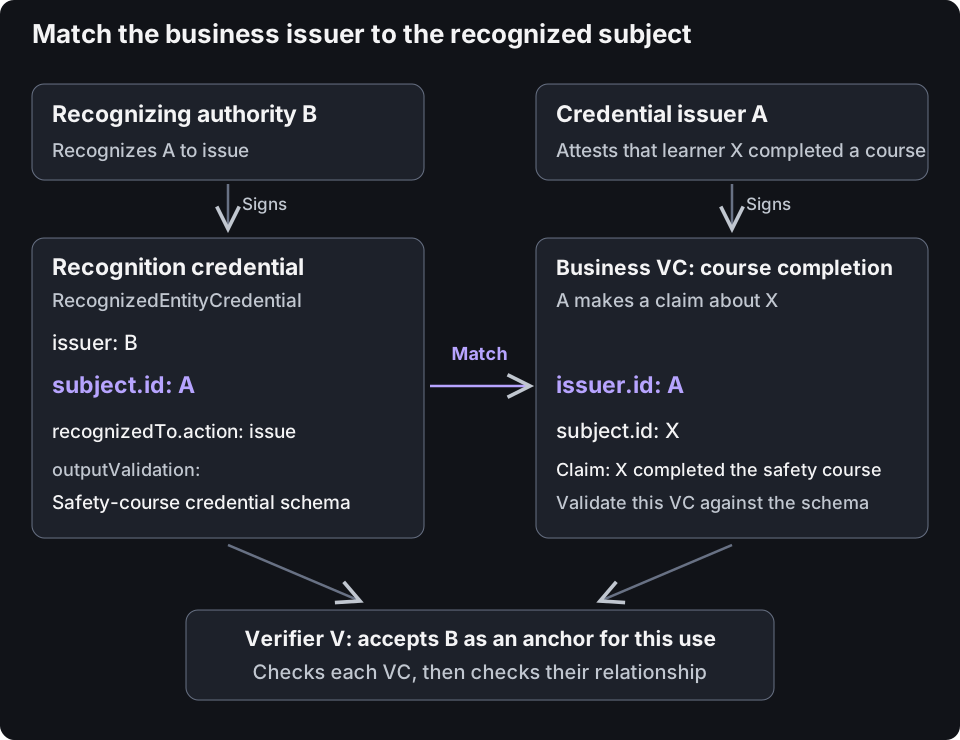
The diagram uses a fictional ecosystem and scrolls horizontally on narrow screens. The party delivering a credential and the party issuing and signing it are distinct roles.
| Field or question | X's completion credential | Recognition VC about A |
|---|---|---|
issuer | Provider A | Council B |
credentialSubject | X's course completion | A, expressed as a RecognizedEntity |
| Matching identifier | issuer.id identifies A | The recognized entity's id identifies A |
| Recognized action | This is the credential being evaluated | A's recognizedTo describes an action such as issue |
| Output constraints | The safety-course credential | If outputValidation is declared, the business VC must satisfy its referenced schemas |
outputValidation refers to schemas describing required structure or constraints. A schema can require particular course-completion fields. It does not perform an on-site assessment of whether a class actually took place. Draft sections 3.2–3.4
Council B does not receive its authority from W3C. In this example, V accepts B as a trust anchor for the use case. If V instead needs to follow B's own recognition, additional recognition VCs enter the path until it reaches an anchor it accepts.
How does the draft discover and validate recognition information?
The draft separates discovery, which gathers candidate evidence, from validation, which determines whether the evidence establishes recognition. Finding a document that mentions A does not complete validation.
Discovering a recognition VC from the business credential
Credential-based discovery uses a recognizedIn reference on the business VC's issuer object. In the training example, A's issuer information can point to the recognition VC published by B.
V obtains that document. If V accepts B, discovery has reached a candidate stopping point. If B is unfamiliar, V can follow issuer.recognizedIn on B's recognition VC to obtain another level of evidence. Draft section 4.1
Discovering it from the issuer's identifier
Identifier-based discovery does not require that reference on the original issuer object. V resolves or dereferences A's identifier to a controlled identifier document, such as a DID document.
If that document declares a service whose types include both WhoisService and PathService, V retrieves a verifiable presentation, or VP, from the specified endpoint. A VP packages credentials for presentation. V verifies that the presentation is bound to A and looks inside it for a recognition VC about A. If the recognizing issuer is also unfamiliar, credential-based discovery can continue the chain. Draft section 4.2
An identifier alone does not make this work. A must publish the appropriate service and data, and V must implement the discovery mechanism.
Applying the same validation regardless of delivery
The algorithms assume that each VC has already been individually validated, including its proof, validity period, and applicable status. Recognition validation then examines the relationships: identifier matches between adjacent credentials, overlapping validity, cycles and depth limits, and whether the final issuer is an accepted anchor.
The result contains two booleans: recognized and actionRecognized. The first concerns recognition through the chain. The second evaluates the issuer of the initial business VC against the action recorded in the next recognition VC, including any declared output schemas. Draft section 4.3
Being listed without a recognizedTo action does not establish action recognition. If issuance authority matters to the transaction, V must not accept recognized: true alone.
Discovery can follow URLs in unverified input. The draft therefore also addresses retrieval restrictions, redirects, time budgets, and depth limits. Validating a response afterward cannot undo an inappropriate request that has already been sent.
Holder delivery and the VCALM example
X can obtain B's recognition VC and provide it with the completion credential. The draft permits delivery mechanisms beyond the two discovery algorithms, including direct holder delivery. V still performs recognition validation.
The non-normative Holder-Based Delivery appendix illustrates a presentation request using VCALM. The verifier requests the business credential and supporting recognition evidence; the holder returns a VP containing both. VCALM is a separate W3C draft addressing VC lifecycle operations. Its use in this example does not make it mandatory for every implementation of Recognized Entities.
Offline evaluation is possible in a suitably prepared deployment, with keys and other necessary information available in advance. Freshness remains a constraint: cached recognition may have been revoked since it was obtained. V needs an acceptable-age policy and may require newer evidence rather than accepting what the holder supplied.
How is this similar to EBSI?
Using a VC to establish an issuer's recognition resembles EBSI's Trust Chain approach. Describing EBSI as a registry and W3C as a VC would create a misleading division.
EBSI's official introduction states that each accreditation is itself a VC stored on its Issuers Registry. It distinguishes a root accreditation organization, accreditation organizations, and trusted issuers, with accreditation paths leading to a root. Its registry and accreditation VCs work together.
B, a regional body, and A in the fictional training example provide a useful way to understand those relationships. They are not a claim that EBSI operates this particular training scheme.
EBSI defines a concrete framework of roles and participation or accreditation procedures. The W3C draft aims to provide reusable representations and discovery and validation processes across domains. Adopting its format does not confer EBSI membership or accreditation.
The preceding Community Group report identifies EBSI, ETSI, TRAIN, and ToIP among the earlier approaches it considered, while explicitly acknowledging incomplete coverage of their concepts. Similar ideas do not establish wire compatibility, equivalent accreditation rules, or support for every earlier feature.
Can it represent both direct lists and hierarchies?
It can describe a direct list of recognized entities and chains of recognition VCs. These map usefully to the two patterns in the earlier article, provided that chain validation is not given broader authority semantics than the draft actually specifies.
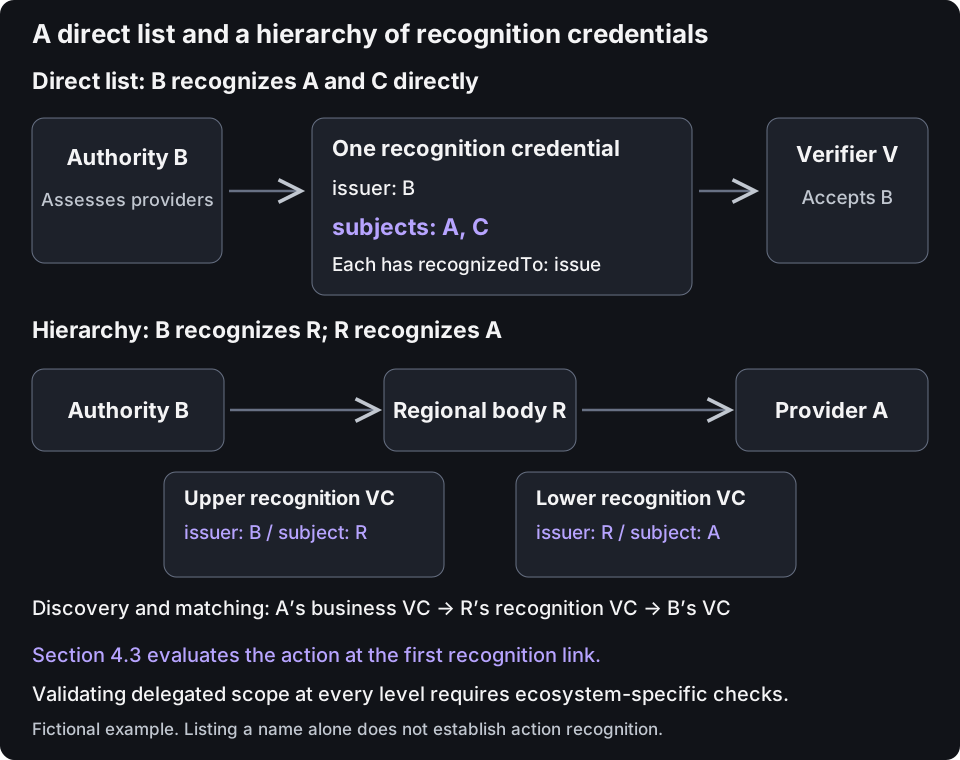
Direct list: B lists A and C
If B assesses every provider directly, it can include A and C in the credentialSubject of one recognition VC. Example 1 in section 3.4 similarly lists multiple universities.
The earlier article's directory analogy meant direct registration of accepted issuers and permissions, not merely a list of contact details. To establish A's recognized issuance action, the entry needs the relevant recognizedTo information. A list suitable for recognizing an organization by name may be insufficient for a transaction requiring issuance authority.
Hierarchy: B recognizes R, and R recognizes A
With a regional body R, B issues a recognition VC about R, and R issues another about A. References on issuer.recognizedIn can connect A's business VC to R's recognition VC and then B's.
V checks that A appears as a subject of R's VC and R appears as a subject of B's. Sections 4.1 and 4.3 describe discovery and relationship validation for such recognition chains.
A recognition path is not complete delegation-scope validation
Section 4.3 evaluates actionRecognized using the first business VC and the next recognition VC. Here, that evaluates whether R recognizes A for the intended action.
It must be distinguished from checking, at every level, that R's recognition of A stays within authority delegated by B. Suppose B permitted R to accredit safety-course providers only in one region, but R recognized a provider in another region or qualification category. Matching the chain's identifiers alone does not establish that the delegation constraints have been respected.
An ecosystem seeking EBSI-style delegated accreditation must therefore specify how roles, permitted accreditation actions, geography, credential categories, and scope restrictions are represented and validated at each step. The ability to traverse a hierarchy does not mean arbitrary delegation policies are already implemented by this draft.
Where do TRQP and existing Trusted Lists fit?
TRQP provides a common query interface to authority information. It is not a mandatory underlying protocol for Recognized Entities. Consider it after understanding the draft's own discovery and validation mechanisms.
TRQP v2.0 is a read-only query protocol for authorization and recognition between authorities. V might query whether B authorizes A to issue a specified credential. Receiving such an answer from a registry and obtaining and validating a recognition VC are related operations, but they are not the same operation.
The November 4 draft does not specify TRQP as required transport. It describes reference-based retrieval and identifier-based service discovery, and uses VCALM in the holder-delivery example. TRQP appears among prior work considered in the preceding Community Group report. That background must be distinguished from a mandatory dependency.
B could publish recognition VCs while also exposing a TRQP endpoint over the underlying authority records. This is a possible architecture, not an interoperability result established here. Identifiers, actions, credential scopes, evaluation times, and revocation updates would need explicit mappings and implementation. This article does not establish a standardized integration binding between the two.
Existing lists are another possible source of evidence. The draft's recognizedIn can refer to an ExternalEntityList, with ETSI lists among the examples. Implementers still need to support the referenced format and its validation requirements.
EU Trusted Lists have a specific institutional role in listing qualified trust services. Referencing or converting their data does not transfer their legal effect to an unrelated training scheme or another jurisdiction.
| Role | Training example | Relevant specification or framework |
|---|---|---|
| Decide recognition | B assesses A | Ecosystem assessment rules and accountability; EBSI provides a concrete accreditation framework |
| Represent the result | B issues a recognition VC about A | W3C draft data model; EBSI also uses accreditation VCs |
| Obtain the evidence | X supplies it, or V retrieves it | Draft discovery methods and holder delivery; VCALM is used in an illustrative presentation exchange |
| Validate evidence and relationships | V checks A, the path, and the intended action | Individual VC checks and recognition validation; additional ecosystem-specific delegation checks where required |
| Answer authority queries | V queries B's registry | TRQP is one possible interface; integration with this draft is not automatic |
FAQ
Must a recognition VC be issued for each completion credential?
No. It describes A's recognition, so it can support more than one business credential, subject to validity, status, and freshness requirements. One recognition VC can also list several recognized entities.
Does a recognition VC make Council B trustworthy?
V still needs a basis for accepting B. Following further recognition evidence ultimately needs to lead to an anchor V has chosen to accept.
Does appearing in a list establish issuance authority?
Not on its own. The draft separates entity recognition from recognition of an action. Transactions requiring issuance authority must check the relevant action rather than relying only on recognized.
Summary and outlook
The earlier articles examined ecosystem-specific recognition structures and TRQP. W3C has now presented a Working Draft for common representation, discovery, and validation of recognition information. The relationship is concrete: the issuer of a business VC is matched to a subject in a recognition VC issued by another party.
The following is an outlook, not an established adoption result. If implementations converge on common recognition VCs, integrations may require less work to interpret a different format for each counterpart. Organizations operating EBSI-style accreditation or Trusted Lists may find opportunities to communicate that evidence more consistently to other participants.
However, mapping authority semantics, agreeing on assessment criteria, updating revocations, and assigning responsibility remain organizational and implementation work. A common format can make those decisions easier to exchange; it does not make them automatically equivalent.
My impression is that this draft is making a serious effort to incorporate useful ideas developed by earlier ecosystems. Representing recognition as VCs, accommodating lists and chains, and separating discovery from validation all connect to that earlier work. This is my reading of the draft, not a claim that compatibility with every predecessor has been verified.
In future projects, I intend to consider compatibility with this specification when designing recognition data and integration points. That does not mean deploying a changing experimental draft in every production system. Adoption decisions still need to reflect project requirements and specification maturity. I will continue watching both the specification and its uptake, including practical work on mappings, scope restrictions, and revocation handling.
In ZenChAIne's development and technical advisory work, these standards developments belong alongside a clear allocation of responsibility for recognition, updates, and acceptance decisions.
References
- W3C: Recognized Entities v1.0, November 4, 2026 Working Draft
- W3C: Discovery and recognition validation, section 4
- W3C: Holder-Based Delivery, non-normative appendix D.3
- W3C Credentials Community Group: Verifiable Credentials for Recognition v0.9
- W3C: VCALM v1.0, October 13, 2026 Working Draft
- EBSI: Introduction to Trust Chains
- ToIP: Approved TRQP v2.0
- European Commission: EU Trusted Lists
Diagrams are original ZenChAIne explanations using a fictional training ecosystem. They do not reproduce official specification figures or logos.